
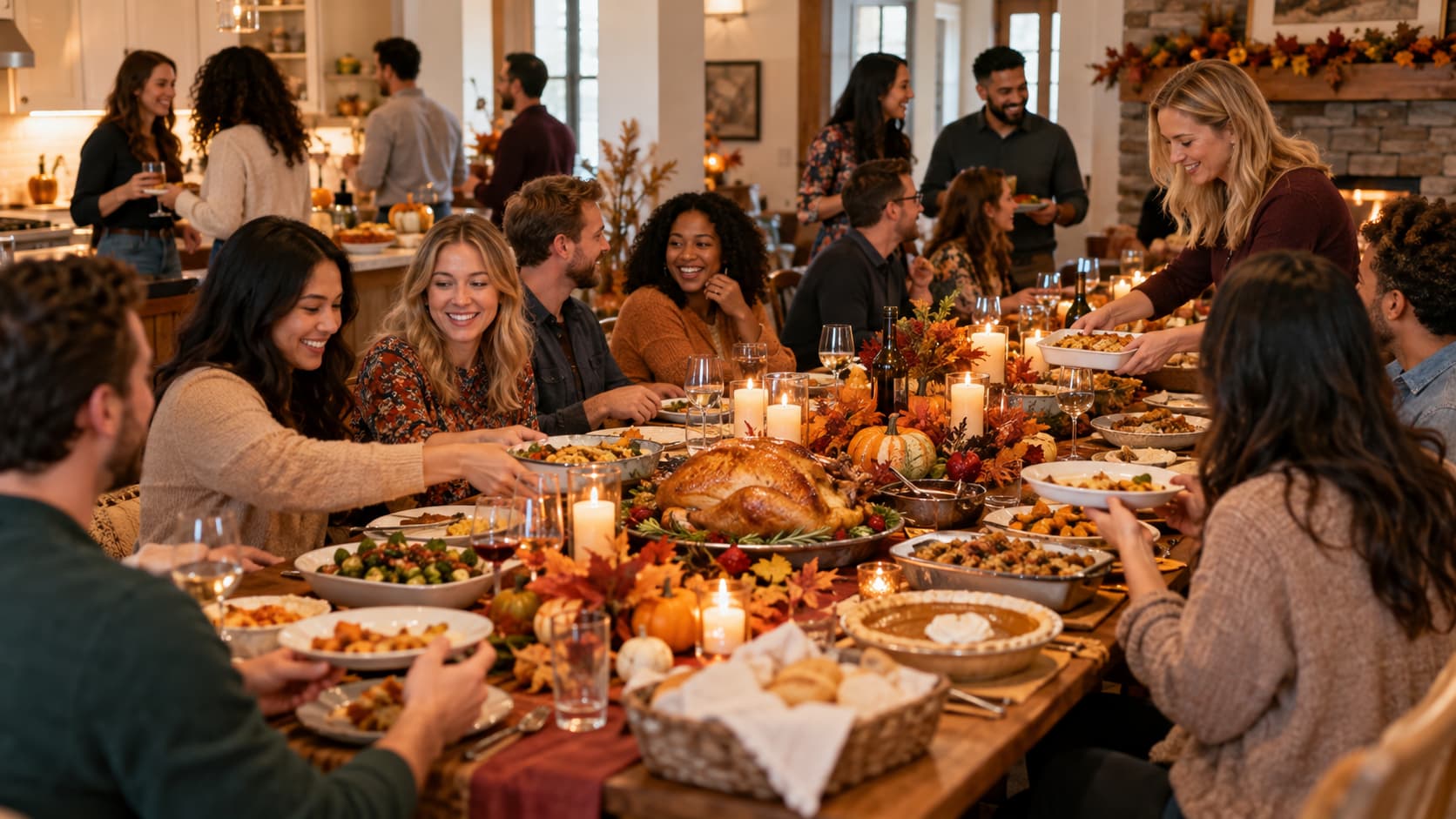
Friendsgiving has become a popular way to celebrate Thanksgiving with friends, roommates, colleagues, and extended social circles. Unlike a traditional family dinner, the gathering usually follows a more flexible format, with guests contributing dishes and sharing hosting responsibilities. In 2026, Thanksgiving falls on November 26, and many groups hold Friendsgiving on the weekend before the holiday, sending invitations three to four weeks in advance. Organizing a celebration for 20-30 people, however, requires more coordination than a casual dinner among close friends.
A successful large Friendsgiving depends on several practical decisions: choosing a suitable location, assigning food contributions, arranging seating, and creating a realistic schedule. With a little preparation, hosts can welcome a large group without spending the entire evening cooking, cleaning, or solving last-minute problems.
Planning the Guest List and Choosing a Venue
The first step is determining how many people will actually attend. A guest list of 25 can easily grow when friends ask to bring partners, roommates, or children. Invitations should therefore clarify whether additional guests are welcome and request confirmations at least two weeks before the event. A shared RSVP form can collect dietary requirements, accessibility needs, and information about children without requiring dozens of separate conversations.
Space becomes particularly important when the group exceeds 20 people. A large living room, shared apartment lounge, community clubhouse, or rented event room may work, provided there is enough space for dining, food service, and movement. Hosts should consider the number of available chairs, bathroom access, parking, and whether guests can move comfortably between tables. If the venue has limited capacity, dividing the gathering into separate dining and social areas can prevent overcrowding.
For groups approaching 30 guests, renting a community room may be more practical than squeezing everyone into a small apartment. Many residential complexes and neighborhood centers offer spaces with tables, chairs, and basic kitchen facilities. Before booking, confirm whether outside food is permitted, what cleaning is required, and whether the room can be used long enough for preparation and cleanup.
Organizing a Potluck Menu for 20-30 Guests
The potluck format is particularly suitable for Friendsgiving because it distributes cooking responsibilities across the group. However, asking everyone to bring something without coordinating contributions can result in several identical casseroles and no substantial main course. A shared spreadsheet or online sign-up list allows guests to choose dishes from specific categories while showing what has already been assigned.
For a gathering of approximately 25 people, a practical menu could include two main dishes, five or six sides, several appetizers, three desserts, and nonalcoholic beverages. Turkey remains a traditional centerpiece, but a vegetarian main course ensures that guests who do not eat meat have something substantial to enjoy. Mashed potatoes, roasted vegetables, stuffing, macaroni and cheese, salads, and cranberry sauce provide familiar options without requiring every guest to prepare a complicated recipe.
Portion planning matters more than the total number of dishes. If six people each bring a side dish intended for 8-10 servings, guests can sample several options without every contribution needing to feed the entire group. Main courses require a more careful estimate based on the number of meat-eaters and vegetarians. The USDA suggests planning about one pound of whole turkey per person, and a frozen bird needs roughly 24 hours of thawing in the refrigerator for every four to five pounds. The host should confirm quantities rather than assuming that a large-looking casserole or one turkey will be sufficient.
Food allergies and dietary restrictions should be addressed before cooking begins. Guests can identify dishes containing nuts, dairy, gluten, or other common allergens, while vegetarian and vegan options should be clearly distinguished. Simple ingredient cards beside serving dishes help people make informed choices without repeatedly asking the cook. For serious allergies, separate utensils and appropriate precautions against cross-contact remain essential.
Food safety also requires planning. According to the USDA, poultry must reach an internal temperature of 165°F, while perishable food should not remain at room temperature for more than two hours. Hot dishes should be maintained at 140°F or above and cold dishes at 40°F or below when they are being held for service. Small serving batches are useful because remaining portions can stay safely refrigerated or hot-held until needed.
Arranging Seating, Serving Stations, and Decorations
A Friendsgiving dinner for 30 people rarely requires one enormous table. Several smaller tables can create a comfortable atmosphere while making it easier for guests to talk. Borrowed folding tables and matching or mixed chairs are usually sufficient, provided they are stable and leave accessible routes through the room. Hosts should count the available seats before the event rather than discovering a shortage when dinner is served.
Separating food and drink stations improves circulation. The buffet should have enough space for guests to move along it without blocking doorways, while beverages can be placed on a different table. A separate dessert area prevents people from crowding around the main meal. Plates, napkins, utensils, and serving tools should be arranged in the order guests will need them.
Decorations can remain simple and seasonal. Small pumpkins, autumn leaves, reusable table runners, and warm battery-operated lights create a Thanksgiving atmosphere without consuming valuable dining space. Low centerpieces are preferable to tall arrangements that interfere with conversation. For a large gathering, comfortable seating and convenient access to food contribute more to the experience than elaborate decorative installations.
Creating a Schedule That Keeps Dinner on Time
Large gatherings benefit from a clear timeline, particularly when several guests are bringing hot dishes. An invitation might specify arrivals at 4:30 PM and dinner at 5:30 PM, giving everyone time to settle in before the meal. The host should ask contributors to bring dishes ready to serve whenever possible, since a household oven cannot reheat several large casseroles simultaneously.
Two or three days beforehand, confirm the menu, serving equipment, and transportation arrangements. Tables, decorations, and nonperishable supplies can be prepared the evening before. On the day itself, reserve the final hour for receiving dishes, checking the buffet, and ensuring that guests know where to place coats and personal belongings. Assigning a friend to coordinate arrivals allows the host to concentrate on the meal.
Entertainment should complement the gathering rather than dominate it. A short gratitude activity, group photographs, or a casual trivia game can give guests something to share without imposing a strict program. Keeping activities optional is especially helpful when some attendees are meeting for the first time and others simply want an opportunity to catch up.
Sharing Expenses and Cleanup Responsibilities
Even a potluck celebration involves expenses beyond the food guests contribute. Tables, disposable or reusable serving supplies, decorations, ice, beverages, and venue rental can add to the budget. Hosts should identify these costs in advance and decide whether they will cover them personally or request a contribution. For example, a group might agree that everyone brings a dish while sharing the cost of a rented room and basic supplies.
Financial expectations should be communicated when invitations are sent, not after the gathering. A simple contribution arrangement prevents one person from unexpectedly covering every expense, and guests who cannot afford additional costs can still participate by helping with preparation or cleanup. Expensive decorations and matching tableware are unnecessary when the purpose is to create a welcoming shared celebration.
Cleanup is considerably easier when responsibilities are assigned before dinner begins. A few volunteers can collect dishes, separate recycling, wipe tables, and return borrowed furniture. Hosts should provide containers for leftovers and encourage guests to take home suitable portions of the dishes they brought. Leftovers should go into the refrigerator promptly, and most cooked leftovers should be eaten within three to four days.
A large Friendsgiving works best when guests understand that the occasion is a shared effort rather than a professionally catered event. Clear assignments, realistic quantities, comfortable seating, and a manageable schedule allow everyone to contribute without placing excessive pressure on the host. The result is a festive dinner that feels personal even when the guest list reaches 30 people.